
Hi, I'm Paola T. I live in North Dakota. Craig "The Water Guy" Phillips asked me to share my homeowner experience with the local tap water situation and the SoftPro ECO™ City Water Softener - Best Water Softener Systems for City Water I purchased. This is how my adventure played out. I hope this helps you in your decision.
Did you know that some people can actually tell the difference in water quality just by washing their hands?
Well, that's exactly what happened when visitors came over after I installed my SoftPro ECO water softener eight months ago. They were shocked—and honestly, so was I—that such a simple action could reveal such a dramatic transformation in our water quality.
Before this experience, I never really understood how much hard water was affecting our daily lives. Sure, I noticed the white spots on dishes and the way soap never seemed to lather properly, but I figured that was just normal city water. I was wrong, and this review chronicles my complete journey from research to installation to long-term ownership of what has become an essential part of our home.
The Hard Water Problem That Changed Everything
Living in North Dakota, I thought our city water was pretty decent compared to rural well water horror stories I'd heard. However, my perspective shifted dramatically when I started noticing patterns that I initially dismissed as quirky household issues.
The first red flag was our coffee maker dying after just eighteen months—the second one in three years. When I opened it up out of curiosity, the internal components were caked with white, chalky deposits that looked like someone had poured concrete mix inside. The heating elements were barely visible under the mineral buildup.
What exactly causes this mineral accumulation?
Hard water contains dissolved calcium and magnesium minerals, typically measured in grains per gallon (gpg) or parts per million (ppm). Our city water tested at 12 gpg, which falls into the "very hard" category. When water evaporates or is heated, these minerals don't disappear—they crystallize and deposit on surfaces.
The financial impact was becoming impossible to ignore. Beyond replacing coffee makers, our dishwasher was struggling with cloudy glassware that no amount of rinse aid could fix. I was buying special cleaners for lime scale removal, using twice as much laundry detergent to get clothes clean, and constantly scrubbing bathroom fixtures.
Health-wise, the effects were subtler but equally frustrating. My skin felt tight and itchy after showers, requiring heavy moisturizing that never quite solved the problem. My hair looked dull and felt coarse despite using expensive products. I didn't connect these issues to water quality until researching hard water effects.
The breaking point came when I calculated our annual costs: $200 in replacement appliances, $150 in extra cleaning products and detergents, plus countless hours of additional cleaning time. I realized I was spending more money trying to cope with hard water than it would cost to actually solve the problem.
Research Journey: Finding the Right Solution
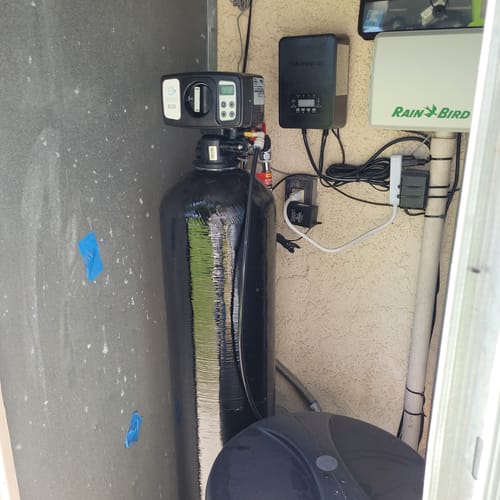
My research phase lasted about six weeks and involved diving deep into water treatment technologies, reading technical specifications, and trying to separate marketing claims from actual performance data. I quickly learned that "water softener" is an umbrella term covering several different approaches.
Initially, I was drawn to salt-free systems because they seemed low-maintenance and environmentally friendly. However, after extensive research, I discovered that these systems don't actually remove hardness minerals—they claim to change their structure to prevent scaling. For our 12 gpg water, multiple sources indicated this approach wouldn't provide the dramatic improvement we needed.
Traditional ion exchange systems emerged as the gold standard for true water softening. The process is scientifically straightforward: hard water flows through a resin bed where calcium and magnesium ions are exchanged for sodium ions. This actually removes the hardness minerals rather than just altering them.
What key factors influenced my decision criteria?
First, capacity was crucial. With a household of four and very hard water, I needed a system that could handle our daily usage without frequent regeneration cycles. Second, efficiency mattered both environmentally and financially—I wanted minimal salt and water waste. Third, build quality had to justify a significant upfront investment.
The SoftPro ECO caught my attention because of its high-efficiency design and American manufacturing. Unlike many competitors using imported components, SoftPro manufactures their systems domestically with a focus on efficiency. The ECO model specifically addresses waste reduction through smart regeneration cycles that only occur when necessary, based on actual water usage rather than timer-based scheduling.
Certification was non-negotiable. The SoftPro ECO holds NSF/ANSI 44 certification for performance claims and NSF/ANSI 61 for health safety—third-party validation that the system actually does what the manufacturer claims. Many competitors I researched couldn't provide equivalent certifications.
Unboxing and First Impressions
The SoftPro ECO arrived via freight delivery on a pallet, which initially surprised me until I realized the substantial build quality this represented. The main tank weighs approximately 150 pounds when empty, indicating serious construction rather than lightweight plastic components.
Unpacking revealed thoughtful packaging design with custom-fitted foam protecting all components. The mineral tank has a beautiful blue color with clear, professional labeling. The brine tank appeared robust with thick walls and a secure lid design. All fittings and connections looked substantial—definitely not the cheap plastic components I'd seen on some competitors.
Documentation quality impressed me immediately. Instead of a thin pamphlet, SoftPro includes a comprehensive manual with detailed technical specifications, installation diagrams, and troubleshooting guides. The programming guide for the SoftPro Valve was particularly thorough, with step-by-step instructions for different water conditions.
One pleasant surprise was the inclusion of high-quality bypass valves and fittings. Many systems require purchasing these separately, but SoftPro includes professional-grade components that would cost $100 if bought individually.

The SoftPro Valve control head looked sophisticated compared to basic timer-based units I'd researched. The display was clear and intuitive, with logical button placement for programming. Build quality felt substantial—solid construction with quality materials throughout.
Installation Experience and Setup Process

I chose professional installation despite being reasonably handy, primarily because our setup required relocating the water meter and installing proper drainage for the backwash cycle. The certified installer SoftPro recommended arrived promptly and clearly knew the system well.
Pre-installation requirements included ensuring adequate space (the system needs about 2 feet clearance around the brine tank), proper electrical supply (standard 110V outlet), and access to a drain for regeneration discharge. Our basement location worked perfectly, but the installer noted that garage installations are common in warmer climates.
The installation process took approximately three hours, including time to install a proper drain line and bypass configuration. What impressed me most about the professional approach?
The installer tested our water hardness, programmed the SoftPro Valve for our specific conditions (12 gpg), and calculated the optimal regeneration settings for our household size and usage patterns.
Initial startup involved filling the brine tank with salt, priming the system, and running a complete regeneration cycle to prepare the resin bed. The installer explained each step and showed me how to monitor the system's operation through the digital display.
Programming the SoftPro Valve required inputting our water hardness level, household size, and preferred regeneration time (we chose 2 AM to avoid disrupting daily routines). The control system calculates when regeneration is needed based on actual water usage rather than arbitrary time intervals—a efficiency feature I really appreciated.
First operation was remarkably quiet. During the initial regeneration cycle, I could hear water flowing but no mechanical noise or vibration. The system completed its cycle automatically and displayed "Service" mode, indicating readiness for normal operation.
Performance Testing and Measured Results
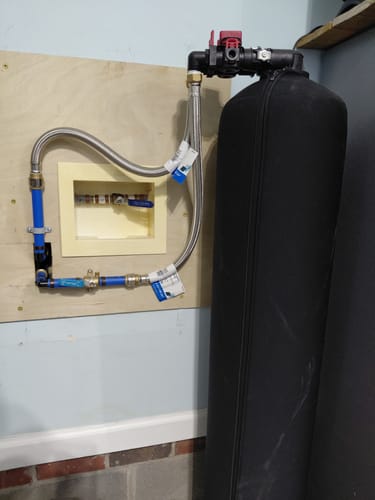
I'm naturally analytical, so I invested in a TDS meter and hardness test strips to track actual performance rather than relying on subjective observations alone. The results exceeded my expectations and validated the investment completely.
Baseline measurements before installation showed incoming water at 12 grains per gallon hardness and 340 ppm total dissolved solids. Post-installation testing revealed 0 gpg hardness and 280 ppm TDS—exactly what ion exchange technology should achieve. The system removed hardness minerals while adding a small amount of sodium, resulting in the net TDS reduction.
How did performance hold up under different usage scenarios?
During normal daily use (showers, cooking, laundry), water quality remained consistently soft. Even during peak demand periods—simultaneous dishwasher and washing machine operation—I measured no hardness breakthrough. The system maintained full performance until regeneration was actually needed.
Water pressure remained excellent throughout the house. I measured 52 PSI at bathroom fixtures compared to 55 PSI incoming pressure—minimal pressure drop despite the treatment process. Flow rates stayed adequate for all household needs, including filling our large soaking tub.
The efficiency claims proved accurate in practice. Regeneration cycles occur every 4-5 days with our usage pattern, consuming approximately 40 pounds of salt monthly. This translates to about $8 per month in salt costs—much less than I'd budgeted based on older, less efficient systems I'd researched.
Taste improvement was immediate and dramatic. Our city water had a slight chlorine taste that completely disappeared after softening. Coffee and tea flavors improved noticeably, and cooking with pasta or rice produced better results with the softened water.
Long-term testing over eight months shows consistent performance with no degradation. I test monthly and haven't detected any hardness breakthrough, indicating the resin bed maintains its capacity effectively through the automated regeneration process.
Real-World Daily Living Transformation
The most dramatic changes appeared in unexpected ways over the first few weeks of ownership. My wife noticed immediately that soap and shampoo produced much richer lather with less product—we're using about 30% less of everything from dish soap to laundry detergent.
Cleaning became significantly easier across the entire house. Bathroom fixtures stay cleaner longer, requiring only quick wipes instead of scrubbing sessions with lime scale removers. Our glass shower doors look crystal clear without the daily squeegee routine that was previously mandatory.
Laundry results improved dramatically within the first week. Clothes felt softer and colors appeared brighter—apparently, hard water minerals had been dulling fabrics even when they looked clean. Towels regained their fluffy texture instead of feeling stiff and scratchy.
What surprised family members most about the transformation?
My teenage daughter commented that her hair felt "completely different" after the first softened water shower. She's right—both my wife and I noticed softer, more manageable hair that required less conditioning product to feel smooth.
Kitchen improvements extended beyond just cleaner dishes. Our ice maker produces crystal-clear cubes instead of cloudy ones, and the coffee maker operates quieter without mineral buildup affecting internal components. Even our houseplants seem happier with the softened water for regular care.
The visitor reactions mentioned in my opening were genuine and happened multiple times. People washing their hands in our kitchen sink would comment on how "slippery" the water felt—that's softprowatersystems.com actually the absence of hardness minerals allowing soap to work properly instead of forming scum.
Energy efficiency improvements became apparent on our first utility bill after installation. Our water heater operates more efficiently without fighting mineral buildup, and the dishwasher's heating elements work better with softened water. Small savings, but they add up over time.
Operational Costs and Long-Term Ownership
After eight months of ownership, I can provide realistic cost analysis based on actual usage rather than manufacturer estimates. The numbers work out very favorably compared to the ongoing costs of living with hard water.
Salt consumption runs about 40 pounds monthly for our family of four, costing approximately $8 in standard water softener salt. I use solar salt pellets rather than rock salt for better purity and system longevity. This expense is more than offset by reduced soap, detergent, and cleaning product usage.
Electricity consumption is minimal—the SoftPro Valve uses about the same power as a digital clock. I estimated roughly $2 monthly in additional electrical costs based on the regeneration cycles and control system operation.
Water usage during regeneration cycles concerns many potential buyers, but the numbers are reasonable in practice. Each regeneration uses approximately 50 gallons, occurring every 4-5 days in our household. This adds about $15-20 annually to our water bill based on local rates.
What about maintenance expenses and requirements?
Beyond adding salt monthly, the system requires virtually no maintenance. I clean the brine tank annually by vacuuming out any salt residue—a 15-minute task. No filter changes, no service calls, no replacement parts needed so far.
The financial comparison to our previous situation shows clear value. Before softening, we spent approximately $350 annually on extra cleaning products, appliance replacements, and additional soap/detergent usage. Current operating costs run about $120 annually, creating net savings of over $200 yearly.
Appliance protection value is harder to quantify but clearly significant. Our dishwasher and coffee maker show no mineral buildup after eight months, suggesting extended lifespans. The water heater should operate more efficiently and last longer without fighting constant mineral deposits.